Product-Level Indoor Navigation: From Supermarket Entrance to Product Shelf
An aisle number answers only part of a shopper’s question. A product-level navigation experience connects a searched item to a mapped destination and guides the customer from the store entrance toward its shelf.
What is product-level indoor navigation?
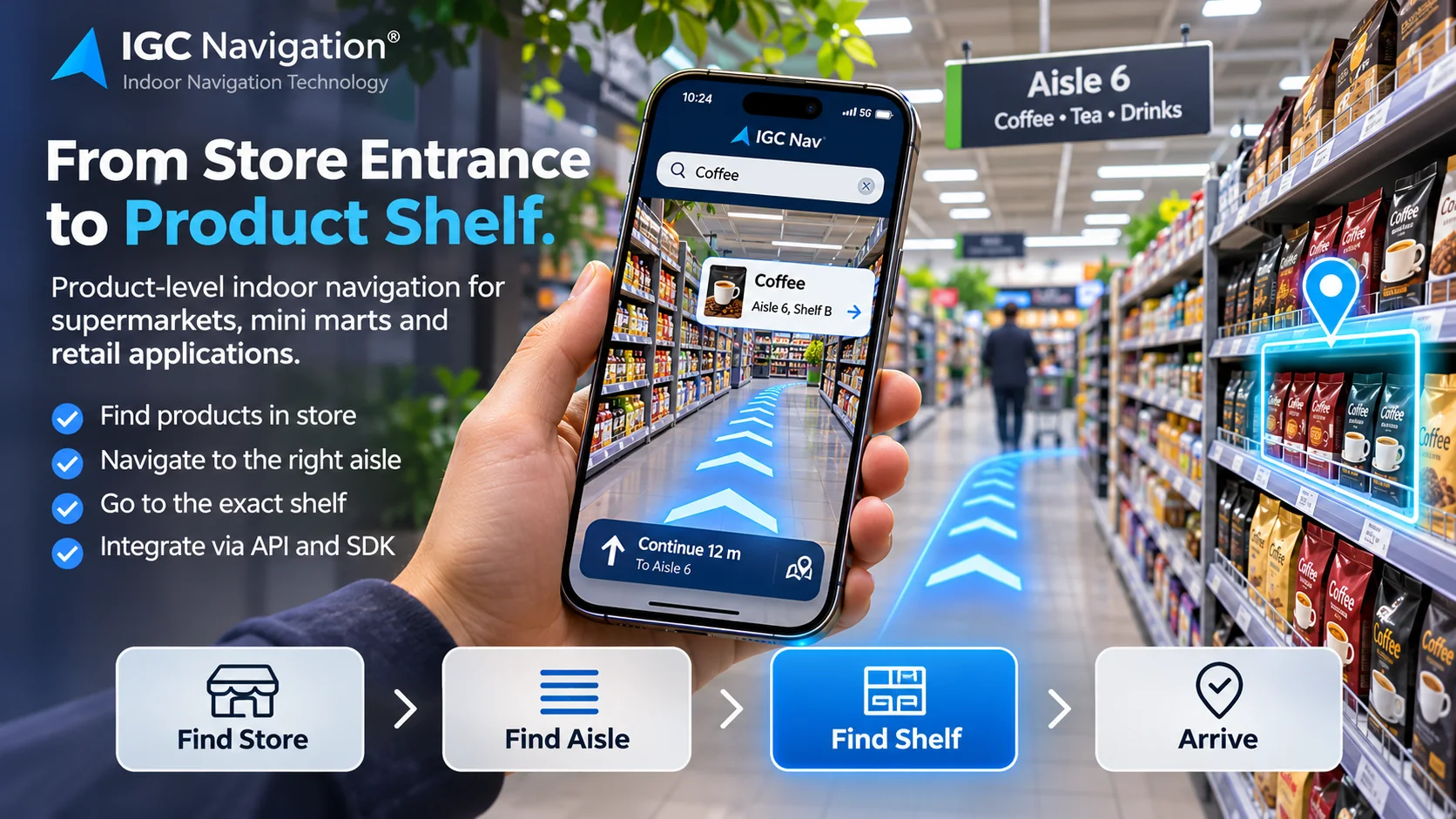
Product-level indoor navigation links a searched retail item to a navigable destination inside a store. Instead of displaying only a department or aisle number, the application can guide a shopper toward an assigned product shelf or display.
A product finder and an indoor navigation system perform different jobs. Product catalogues answer what the customer wants. Store-location data answers where it is. Indoor guidance connects a shopper's current position with that destination.
From finding a supermarket to finding the right shelf
A complete journey can begin with store discovery, continue through entrance guidance and aisle finding, and finish at a designated shelf destination. The precise experience depends on the retailer's data and the navigation integration.
For example, a shopper searches for coffee, selects the product, and the retailer's application resolves that item to a saved destination such as Aisle 6, Shelf B. Navigation can then guide the shopper toward that location. The example illustrates a workflow, not a claim of a verified deployment in a particular store.
Why an aisle finder alone is not enough
A supermarket aisle finder can reduce the search area, but shoppers may still face many shelves, bays and product variants. Shelf-level wayfinding aims to make the final part of the journey clearer.
It is important to distinguish reaching a mapped shelf from identifying a specific packet. Fine-grained item recognition, current stock and item-level availability are separate features that require appropriate retail data or additional technology.
How product locations connect to navigation
A retailer can map a catalogue identifier or SKU to a location record, then associate that record with a navigation destination. One shelf destination may serve multiple SKUs; an end-cap promotion may have its own destination.
As assortments or store layouts change, the retailer needs a maintained product-to-location mapping. Navigation alone does not detect catalogue changes, stock levels or planogram updates. Those require retailer systems and integration work.
Indoor navigation without a beacon installation
IGC Navigation develops smartphone-based indoor navigation capabilities designed to avoid the need for a store-wide Bluetooth beacon network. API and SDK integration options can help developers connect mapped destinations to their own shopping applications.
Location confidence and route accuracy vary with devices, venue characteristics and mapping quality. Retailers should validate continuous guidance, wrong-turn recovery and arrival behaviour inside representative stores before commercial rollout.
Integrate, adapt or commission a retail solution
IGC Navigation supports a developer-oriented path for adding navigation to existing mobile applications, and offers discussions around tailored retail implementations. Turnkey mini-mart and supermarket examples are in development, with commercial readiness dependent on validation.
For teams planning a supermarket product locator app, a strong pilot measures successful arrivals, route consistency, mapping maintenance effort and the clarity of the customer experience, not just a best-case distance reading.
Explore retail navigation and developer resources
Read more about indoor navigation for supermarkets and retail stores, our supermarket navigation integration overview, and IGC Navigation’s shelf-level positioning work.
Developers can explore the navigation sandbox, indoor navigation API and technical documentation. Retail operators can contact IGC Navigation about custom retail development.