Why Indoor Navigation Needs Sensor Fusion: Beyond GPS and Beacons
How sensor fusion, pedestrian tracking, floor estimation and camera-assisted corrections help address the challenges of beacon-free indoor positioning and multi-floor wayfinding.
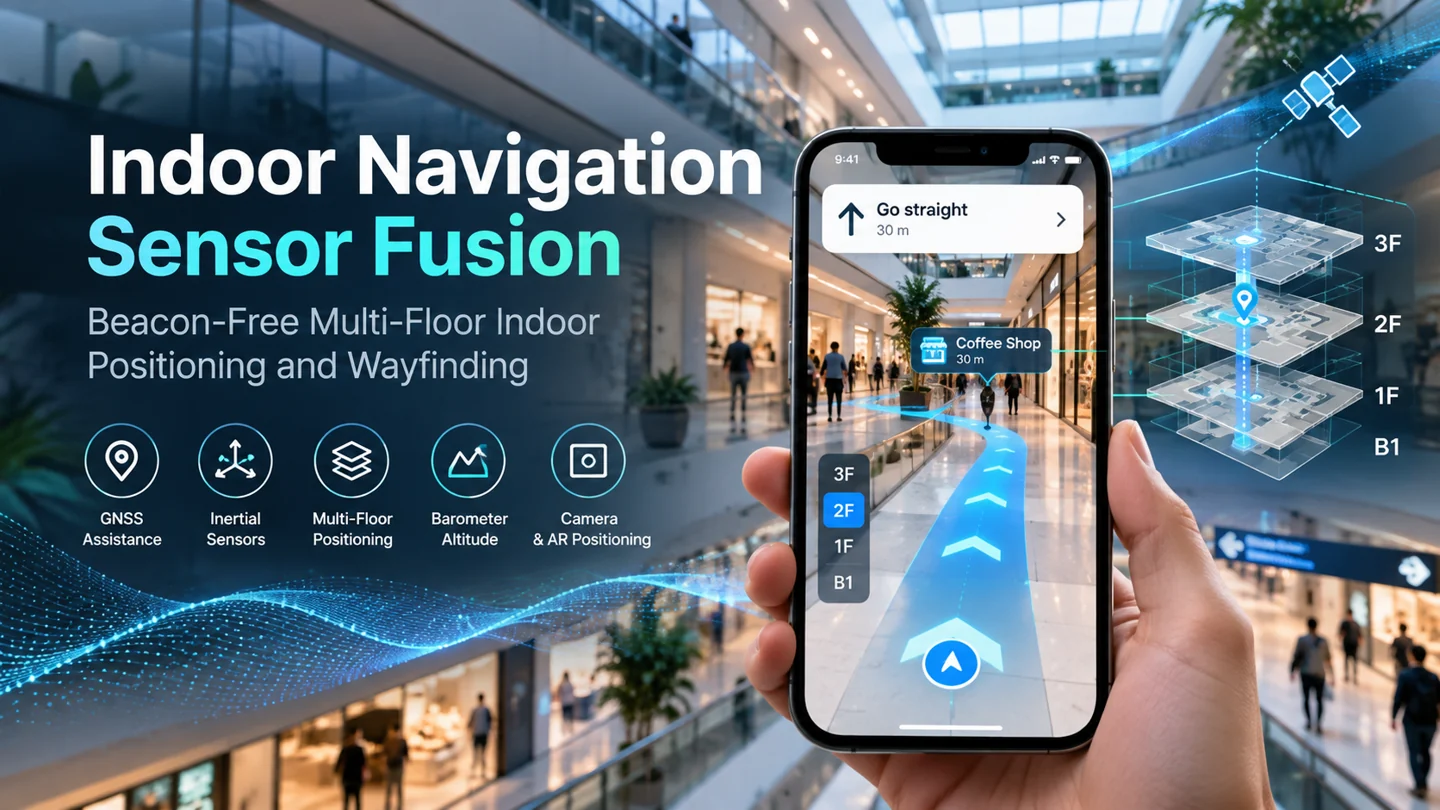
Why indoor GPS navigation is difficult
Outdoor navigation relies heavily on satellite positioning. In shopping malls, airports, hospitals and hotels, satellite signals can be blocked, reflected or weakened. A phone can report a position without reliably identifying the correct corridor or floor. Indoor navigation therefore needs more than outdoor GPS coordinates.
Many indoor positioning systems use dedicated Bluetooth beacons or other installed equipment. Beacon-free indoor wayfinding explores how available smartphone sensors, visual information and building data can support the positioning process without deploying dedicated beacon infrastructure.
What is indoor navigation sensor fusion?
Indoor navigation sensor fusion combines complementary positioning and movement observations rather than relying on one input. Smartphone accelerometers detect acceleration, gyroscopes observe rotation, magnetometers inform orientation and barometers can help detect elevation changes where available. Camera observations and GNSS near entrances can provide additional references.
Every observation has limitations. Magnetic headings can be disturbed indoors, movement estimates drift, and visual landmarks may not always be visible. The purpose of fusion is to use useful evidence while accounting for uncertainty.
Pedestrian dead reckoning for indoor movement
Pedestrian dead reckoning (PDR) estimates travel using steps, heading and movement classification. A navigation system can infer whether a person is moving, stopping or turning while tracking an approximate path between reference observations. But small errors accumulate, so PDR benefits from periodic corrections.
The IGC Navigation Fusion Engine includes step detection, heading estimation and motion classification components. These provide inputs to its broader indoor positioning architecture.
Why extended Kalman filtering is relevant
Kalman filtering is a widely used approach in robotics and navigation for combining predicted states with new measurements while representing uncertainty. An Extended Kalman Filter (EKF) supports nonlinear motion and measurement relationships.
The IGC Navigation Fusion Engine includes a pedestrian EKF component. Its role in the architecture is to support position estimation using movement information and corrections. Specific internal filter design, parameters and weighting methods remain proprietary.
Multi-floor indoor positioning and vertical movement
Indoor wayfinding must handle stairs, lifts, escalators and floor numbering conventions that differ between buildings. A venue may skip floor 13, have mezzanines or use different labels for ground level.
Barometer readings can contribute evidence about vertical movement, while building floor models can help interpret that movement. Not every Android phone has a barometer, which makes device-aware design important. The IGC Navigation architecture includes floor estimation, floor tracking, vertical motion and virtual-barometer components. Device-specific fallback performance needs to be evaluated across different handsets and venues.
For a practical venue application, see indoor navigation and wayfinding in shopping malls and multi-floor navigation for hotels and resorts.
Camera-assisted positioning and visual reference points
Camera observations can help recognise a known location and correct a position estimate. Augmented reality reference points can also associate digital experiences with a physical place. IGC Navigation's application includes ARCore-related and text-recognition components that can contribute visual evidence to its positioning design.
Camera-based assistance is complementary to inertial movement tracking, not a guarantee of precise positioning in every lighting condition or on every phone. Real-world anchor recognition, compatibility and positioning results require testing.
Why positioning confidence matters
An indoor navigation interface should not treat every measurement as equally dependable. Uncertain heading, drift, poor satellite reception or missing visual references can all affect guidance. Confidence-aware processing helps distinguish a useful observation from a weak one and informs how directional instructions should be presented.
The Fusion Engine contains confidence-related components. The precise uncertainty calculations and guidance thresholds are not disclosed in public technical content.
Beacon-free positioning without dedicated installations
A software-led approach can reduce dependence on dedicated beacon hardware, with potential benefits for installation and maintenance. Building data, compatible smartphone capabilities, calibration and validation still matter. Beacon-free does not mean zero configuration or identical performance in every building.
Learn more about IGC Navigation's beacon-free indoor navigation API and our developer-focused integration approach.
Building indoor navigation applications with an API
Developers working on mobile apps, venue services and location-based experiences need an integration path that separates application features from complex positioning infrastructure. IGC Navigation is developing SDK and API resources to support indoor positioning and wayfinding integrations.
Explore the available API documentation, developer plans and Flutter indoor navigation guide. Supported methods and device capabilities should be checked against the current documentation and tested with your intended deployment.
Indoor wayfinding is more than a map
Reliable indoor navigation involves interpreting movement, vertical transitions, visual information and uncertainty. Sensor fusion provides a practical foundation for combining those sources. IGC Navigation's approach brings together on-device positioning components and a developer-oriented platform to support beacon-free multi-floor navigation.
Explore the technology at IGC Navigation or register for a free developer account.